Learn
Methods, models, metrics, and best practices for measuring brand equity

What is brand research?
Brand research is the process of understanding how a brand lives in people’s minds. It involves measuring what David Aaker has described as brand equity, the value beyond just the product, and the drivers behind awareness, associations, perceived quality, and loyalty.
In short: what memories and emotions come to mind when people encounter your brand? Do they think of your brand in contexts that might lead to conversion?
The most common brand research methods: qualitative vs quantitative
The two primary brand research methods are qualitative (which uses conversations and descriptions) and quantitative (which uses large numbers of responses to validate trends). But there are several methods within these buckets that could be utilized.
Qualitative methods
Method | Description |
|---|---|
In-depth interviews | A one-on-one conversation that asks participants to answer a series of questions related to the brand and what associations they have with it. These are excellent at uncovering the rationale behind complex customer behaviors, but they can be expensive and time-consuming for research teams to conduct. |
Ethnography and contextual inquiry | A study comprised of observing how people behave in their natural environments to understand unprompted truths. This can look like observing how people behave near a case of a brand’s product, outside a store, or even their comments on Facebook. |
Focus groups | Group conversations where respondents give their insights in conversation with one another. These are useful for stimulus-response (responding to ads, seeing a package design, etc.), but can be harmful for actual opinion measurement. Group dynamics often give way to performative dissent or conformity to a single, dominant voice. |
Quantitative methods
Method | Description |
|---|---|
Brand tracking | A recurring, quantitative survey program that measures awareness, consideration, perception, and usage over time. Measuring these factors over time is important for managing the brand’s perception, and should be done through short surveys conducted quarterly. |
Brand health surveys | Periodic deep dive surveys into the state of the brand. These are useful when you have a specific strategic question (Should we enter this category? How did that campaign go? Where are we at before we start the upcoming rebrand?). |
MaxDiff (best-worst scaling) | A tool that asks customers to rank-order attributes, claims, or features without the rating scale bias of traditional surveys. |
Conjoint analysis | Consumers are asked to make trade-offs that resemble real-world purchase decisions based on pricing, feature bundles, and package configurations. This is best for measuring price sensitivity. |
The most common brand research models (and when to use each)
It’s not just about the method. You need a model to determine which metrics you should track and evaluate. Here are the four most common models for brand research and what they measure.
Model | Description |
|---|---|
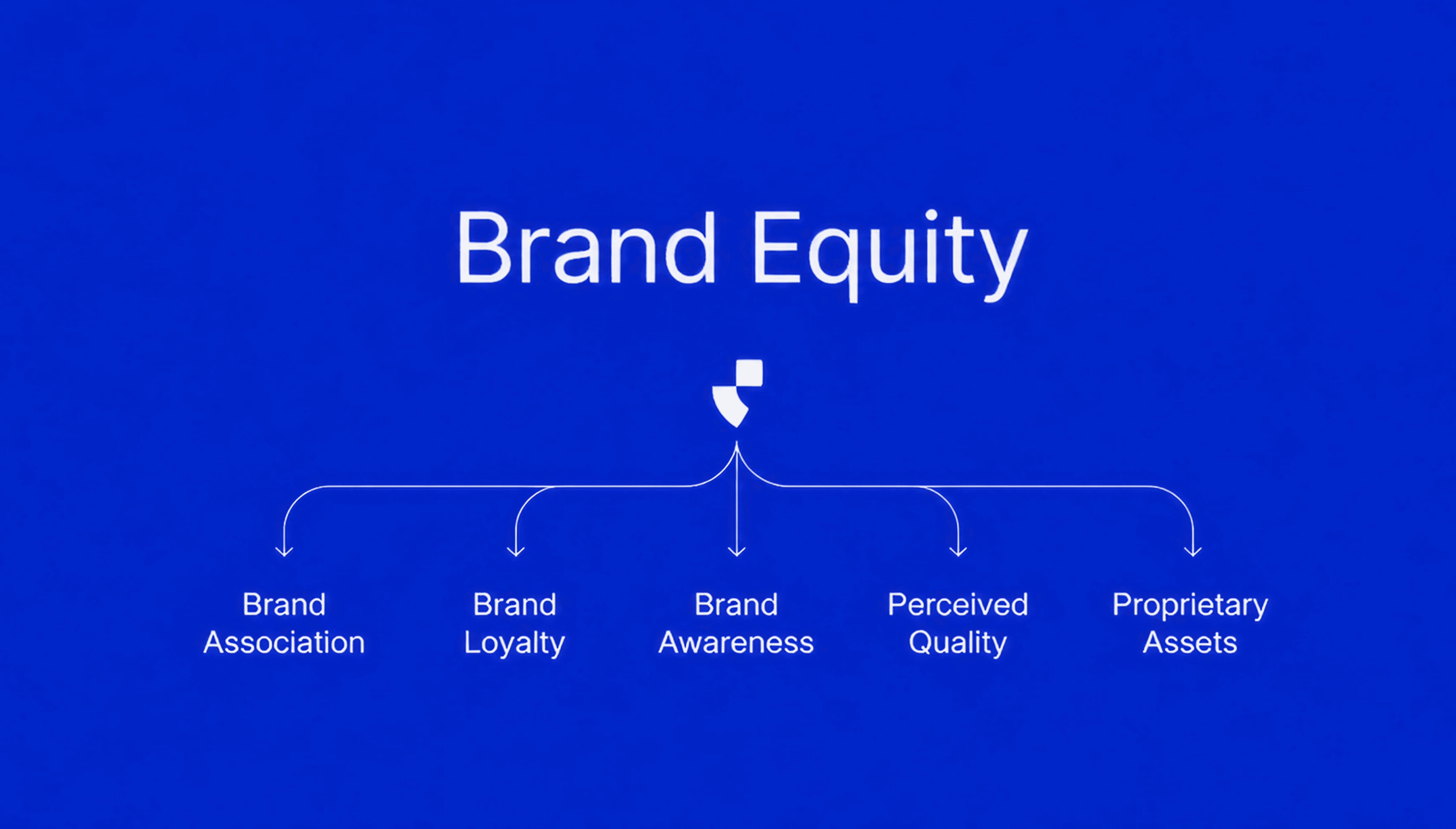
Aaker’s Five-Asset Model | The five metrics you should track are brand loyalty, brand awareness, perceived quality, brand associations, and other proprietary assets. It’s the most cited and useful as a diagnostic checklist. |
Keller’s Customer-Based Brand Equity (CBBE) pyramid | It starts with basic awareness and climbs from there. Salience to Performance/imagery to judgments/feelings to resonance. This is the model most useful for talking to executives because of its intuitive structure. |
Young & Rubicam’s Brand Asset Valuator (BAV) | This assesses brands on differentiation, relevance, esteem, and knowledge. It’s less used, but it predicts which brands have growth potential with the relevance x differentiation grid. |
Kantar’s BrandZ pyramid | distinct from Keller’s, it moves from presence to relevance to performance to advantage to bonding. This model is most closely tied to financial valuation and is best for global, cross-category benchmarking. It won’t work well for diagnosing a specific brand problem. |
The exact model you use is less important than the fact that your organization has one and is using it consistently. Pick one that makes the most sense for your brand and its research goals and use it regularly.
The 5 assets of David Aaker's brand equity model:
The role of brand research in business
Brand research drives strategic decisions across product development, marketing, and customer engagement to enhance brand equity and loyalty. Once you understand your customers’ attitudes, behaviors, and preferences, you can tailor your offerings and messaging to meet market demand. When you have a brand that resonates deeply with consumers, your customer base becomes loyal and your market position distinct.
Brand research with AI
Brand research is undergoing an important shift as more companies turn to AI to avoid the outdated forced trade-off between qualitative depth and quantitative scale.
A few years ago, brands faced a choice: run a few in-depth interviews for rich data (on a tiny sample) or a larger survey for broad, but emotionally thin, data. Most teams didn’t have the team, time, or resources to do both, and many couldn’t justify any qualitative research at all.
But now, AI-moderated interviewing is changing the approach to combine the insights of qualitative research with the scale and speed of quantitative research. Some modern platforms can run thousands of one-on-one, dynamic conversations simultaneously in 50+ languages, and synthesize the results into themes, personas, and quotes within hours.
This helps brand research teams achieve a few things they couldn’t with just traditional methods:
Brand trackers that are actually qualitative. Instead of grids of agree/disagree statements, an emerging approach in the next generation of trackers is to have recurring conversations with hundreds or thousands of category buyers, where each respondent is dynamically probed on their own answers. You do not get a number that says "perceived modernity declined 3 points." You get the number and 600 verbatim explanations of why, organized into themes.
Speed parity with the marketing cadence. Brand teams now operate on a weekly content drop schedule and quarterly campaigns. Research timelines of "eight weeks from question to deck" are no longer compatible with how brands run. Compressing that to days or hours is not a luxury; it is a survival requirement for the insights function.
Outlier capture at scale. Surveys are designed to surface the median. They are less effective at surfacing the unusual, the early-warning signal, the niche need that becomes the next category disruption. Sweetgreen CEO and co-founder Jonathan Neman put this explicitly: "Surveys often miss the outliers, and at Sweetgreen, understanding outliers helps unlock some of our best ideas."
Reduced moderator and social-desirability bias. Research on AI-moderated interviewing has shown participants frequently report feeling less judged by an AI moderator than by a human one. Roughly 60% of users in one Listen Labs study cited "lack of judgment" as a key advantage. For sensitive brand topics (e.g., stigma categories, premium pricing questions, brand-rejection rationale), this suggests that AI-moderated interviews yield more honest data.
AI as a trusted research collaborator: Listen Labs
At Listen Labs, we’ve built a research collaborator that helps organizations run studies that are both fast and meaningful, while keeping humans in the loop to ensure the best results.
AI conducts one-on-one in-depth interviews at scale, asking open-ended questions, listening, and dynamically probing deeper into each answer, much like a skilled human moderator would. Across thousands of respondents simultaneously, it can uncover insights 5x faster than traditional methods and provide initial analysis that surfaces recurring themes in responses.
A typical concept test that would take three weeks and ~$15,000 with traditional methods runs in roughly three hours on the platform, with initial reports auto-generated in under a minute. That’s 5x the research output at one-third the cost, with responses three times as long as those collected in traditional surveys.
That was the experience of Sling Money, a global fintech company operating across 140 countries, built on a simple premise: sending money worldwide should feel as easy as sending a text. But building a brand that feels local in dozens of markets simultaneously is one of the hardest brand research problems a team can face. Every market has its own terminology, trust signals, and cultural expectations. Getting that wrong would erode the brand equity they were trying to build.

Before Listen Labs, Sling Money's research relied on one-off interviews and ad-hoc surveys. It was time-intensive, hard to scale, and impossible to run across markets simultaneously.
With Listen, that changed. When preparing for a product launch, the team needed to know which terminology felt most natural to users across different countries: "payment methods," "funding sources," or "payment instruments." They ran localized AI interviews through Listen across multiple markets in users' native languages, delivering results within hours. The data was unambiguous: people overwhelmingly preferred "payment methods." A brand language decision that would previously have required weeks of coordination was resolved in an afternoon.
Listen works with brand and consumer insights teams to run research that is faster, deeper, and more honest than traditional methods without the tradeoffs. Whether you're tracking brand perception across markets, testing messaging before a campaign launch, or trying to understand why customers choose you over a competitor, we can help you get there in hours, not weeks.
Book a demo to get started.
How to conduct a brand research project: best practices
1. Ask the right questions
The success of a study comes down to the questions that get asked. Good brand research questions are specific, strategically motivated, and tied to a decision your team needs to make. "How is our brand perceived?" is not a research question. "Do consumers in our target segment associate us with quality or value, and which of those associations is driving consideration?" is.
Brand research questions should be distinct from product satisfaction questions. A customer might love your product but have a weak or confused perception of your brand. It’s important not to conflate the two when designing your study.
2. Select the right audience
Almost as important as what you ask is who you ask. For brand research, your study should typically aim to include current customers, lapsed customers, and category buyers who haven't chosen your brand. Each of them will give you a different angle on your brand equity. The most common mistake is over-indexing on your existing customer base, which produces a flattering but incomplete picture.
Segment your audience thoughtfully. Different customer segments can hold radically different perceptions of the same brand simultaneously, and collapsing them into a single sample will average out the most important differences. Define your segments before you recruit. Listen Labs has built-in panels that can help with recruiting or can be integrated with your own to make the process smoother.
3. Run the study
This is where the method you selected earlier comes into play. A brand health survey goes into the field. AI moderates conversations with hundreds of respondents. An ethnographic study moves into observation.
However you run it, two problems have historically plagued this stage: availability and bias.
On the availability side, coordinating moderators' and participants' schedules can create bottlenecks, stretching the process into months. On the bias side, even highly skilled human moderators introduce variability. Respondents also behave differently in front of others than when they feel unobserved, particularly on sensitive brand topics such as premium pricing, brand rejection, or stigmatized categories.
AI-moderated interviewing addresses both. Studies run asynchronously, so participants complete interviews on their own time, across time zones, without scheduling constraints. And research we conducted on Listen’s platform shows that participants report feeling less judged by an AI moderator, leading to more honest, unguarded responses on the very topics brand research most needs to get right.
4. Analyze the results
Analysis begins with organization: grouping responses by theme, segment, and sentiment before drawing conclusions. Resist the urge to confirm what you already suspected.
Connect quantitative metrics to qualitative explanation wherever possible. A three-point drop in perceived differentiation is an interesting data point. Understanding the 200 verbatim responses behind it tells you what to do next, which is unlocked by AI-captured video responses.
5. Connect the brand metrics to business outcomes
The last step is translating what you found into business decisions, such as marketing strategy, pricing, or creative direction. It also includes deciding what areas your brand needs to investigate next.
Build a feedback loop. The brands that get the most value from brand research are those that run research consistently enough that each study informs the next and can show stakeholders a clear line from insight to action to outcome.
The most common brand research metrics
Here are some of the most common metrics to discover and track in brand research.
Model | Description |
|---|---|
Brand awareness | Have you heard of our brand? You can measure this in an aided or unaided way. Aided awareness tells you whether you exist in someone’s recognition memory (Have you heard of Sweetgreen?). Unaided awareness tells you whether you exist in someone’s recall memory within a specific buying situation (When I say 'healthy lunch,' what brands come to mind?”). The latter is far more valuable. |
Mental availability | To capture mental availability, you need to measure associations across multiple Category Entry Points (CEPs) – the moments, occasions, and triggers when a category comes to mind – rather than asking the abstract "what brands do you know in X." This avoids the mistake traditional awareness metrics can make which is conflating recall with recognition, missing the situation-specificity of how people actually buy. |
Brand equity | The differential value the brand adds beyond the bare product. Strong brands command price premiums, generate higher repeat rates, accelerate new product acceptance, and weather competitive shocks better than weak brands. |
Brand health | The operational version of equity. The ongoing diagnostic on whether the brand is gaining or losing the mental and behavioral assets that drive long-term growth. It usually combines awareness/consideration metrics, perception measures, NPS or recommendation metrics, and category-specific health KPIs. |
Brand perception | What do people think the brand stands for? Brand image is its visual analog. Both are measured through attribute batteries, projective techniques, and, increasingly, unprompted social listening. It’s important to study this with a segmented audience because different segments can hold radically different perceptions of the same brand simultaneously. |
Brand trust | A specific perception measure that has gained outsized importance in regulated and high-stakes categories (financial services, healthcare, food). It is also the single perception metric most prone to halo effects because people who like a brand will rate it as trustworthy, almost regardless of evidence. |
Brand differentiation | Do consumers see the brand as meaningfully different compared to others in your category? Some people would say that distinction (standing out) matters more than being different. The truth is that you need both. Distinctiveness gets you noticed, and differentiation gets you chosen. |
Brand associations | The network of attributes, feelings, occasions, people, and meanings consumers connect to your brand. They are the building blocks of perception, and they are what good qualitative research is uniquely suited to surface. The deeper the network, the more salient and resilient the brand. |
FAQs
What’s the difference between brand research and market research?
Market research is a broader discipline that examines the market size, competitive landscape, pricing dynamics, demand trends, and consumer segmentation. It’s the study of the landscape you’re competing in. Brand research is a subset of that work, focused specifically on how your brand lives in people’s minds within that landscape. It measures perception, association, emotion, trust, and meaning. In other words, the intangible assets that determine whether someone chooses your brand over a functionally similar alternative.
What’s the difference between brand research and user research?
User research (UX research) is product-driven. It studies how people interact with a specific interface, feature, or experience. Can they find what they need? Does the flow make sense? Where do they drop off? It is mostly behavioral, focusing on what happens after someone has already chosen your product. Brand research operates earlier in the decision chain. It asks why someone would choose your brand at all. What does it mean to them? How does it make them feel? Does it come to mind in the right moments? The disciplines complement each other, and the best insights come from teams that use both.
What’s the difference between brand research and brand tracking?
Brand tracking is one specific method within brand research. It’s a recurring quantitative survey that measures brand health metrics (awareness, consideration, perception, preference) over time. But it shouldn’t be the only tool insights teams are using to evaluate your brand. Brand research is a broader practice to understand through qualitative interviews, message testing, and more, to understand why your brand is understood in the way it is. Tracking without deeper brand research is like monitoring without understanding why things are the way they are or how you can improve them.
What are the most common brand research models?
The four most widely used frameworks are Aaker's Five-Asset Model, Keller's Customer-Based Brand Equity (CBBE) pyramid, Young & Rubicam's Brand Asset Valuator (BAV), and Kantar's BrandZ. Each measures brand equity from a slightly different angle. Aaker as a diagnostic checklist, Keller as a journey from awareness to emotional resonance, BAV as an early-warning grid, and BrandZ as a financial valuation tool. For a full breakdown of what each model measures and when to use it, see the methods section above.
Will AI replace humans in brand research?
No, and we wouldn’t want it to. AI is great at tasks that have historically made research slow and expensive, such as transcription, pattern recognition, and easier interview scheduling. What it doesn't do is know which questions are worth asking, recognize the significance of an unexpected answer, or make the judgment call about what a finding should mean for your business. The most effective research programs treat AI as a force multiplier for human researchers. At peak functioning, it should be a trusted research collaborator.
When should I conduct brand research?
Foundational brand research is often conducted annually, with additional studies to track movement throughout the year. It’s best to conduct brand research regularly, with a quarterly cadence ideal. That kind of regularity is necessary to track changes in your brand’s perception as they occur, rather than after a long enough period, when it’s too late to do anything about it, or when the data is too outdated to be useful to creative teams.
What’s the difference between brand loyalty and brand preference?
Brand preference is what someone says they would choose. Brand loyalty is what they actually choose, repeatedly, when given a choice. In many categories, “loyal” buyers are simply habit buyers with low switching motivation. True loyalty is rarer than most brand teams admit. Measure both, and don’t confuse a stated preference for a behavioral one.