Learn
A direct comparison of 14 AI research platforms for 2026, across AI-moderated interview tools, hybrid qual and quant platforms, usability testing tools, and legacy enterprise systems now adding AI.
Overview
This guide is for insights professionals, UX researchers, marketers, and product teams at mid-market and enterprise organizations evaluating AI research platforms as part of a purchasing decision. Each tool below is reviewed across four dimensions: what the platform is and who it is built for, its capabilities, and an assessment of where it fits best and where it may not be the right choice.
The 14 platforms covered:
Listen Labs: end-to-end AI research platform covering study design, recruitment, AI-moderated interviews across video, voice, and text, fraud detection, multimodal emotional analysis, and Mission Control, a cross-study knowledge base that compounds research over time
Qualtrics: dominant legacy survey platform with AI summarization layered on top
Conveo: AI-moderated interview platform focused on video and voice for consumer insights and market research teams
Outset: AI-moderated interview platform with Figma and screen-share integration for UX and product teams
Strella: AI-moderated interview platform for conversational consumer research across voice and video
GetWhy: AI video research platform for global B2C brands running concept testing and creative evaluation
UserTesting: unmoderated usability testing platform with a large participant network
Voxpopme: enterprise video feedback platform with AI moderation added to its core video survey offering
Maze: prototype and product testing platform with deep Figma integration for UX teams
Dscout: enterprise mobile and longitudinal research platform with AI analysis layered on
Userology: UX-focused AI interview platform with vision-aware moderation
Marvin: research repository and knowledge management platform with AI-moderated interviews added
Knit: hybrid qual and quant research platform combining AI moderation with survey-style quantitative research
Discuss: qualitative research platform supporting both human-moderated and AI-moderated sessions
Evaluation criteria
Seven criteria separate AI research platforms that hold up under enterprise use from those that work only for narrow studies:
Modality coverage. Video, voice, text, and structured quant where needed.
Adaptive AI moderation. Whether the AI probes in response to what participants actually say, or runs linearly through a script.
End-to-end workflow. Whether recruitment, moderation, analysis, and delivery live in one platform or require stitching tools together.
Cross-study infrastructure, the model Listen Labs calls Mission Control. Whether findings compound over time in a searchable knowledge base, or live as standalone study artifacts.
Traceable outputs. Whether AI-generated insights link back to source quotes and moments, or stand alone as summaries stakeholders have to trust.
Time-to-first-insight. Not just how fast a study runs, but how quickly a first coded theme appears and how soon a stakeholder-ready deliverable follows.
Enterprise fit: integrations, compliance, and pricing transparency. Native CRM, data warehouse, and BI integrations matter for any team connecting research to business data. Modern compliance certifications are table stakes for regulated industries. Pricing transparency matters because most AI research platforms are contact-for-pricing.
For teams running ongoing research programs that need recruitment, AI moderation, fraud detection, analysis, and delivery in one workflow, Listen Labs is our recommendation.
Quick Comparison
Use the table below to narrow your shortlist by category, fit, and recruitment model before reading the deeper reviews.
Platform | Category | Best for | AI depth | Recruitment included |
|---|---|---|---|---|
Listen Labs | End-to-end AI research platform | Enterprise programs spanning brand, creative, product, and UX with Mission Control compounding every study | End-to-end moderation across video, voice, and text with emotional intelligence and cross-study synthesis | Curated recruitment and custom audience sourcing across global B2C and B2B participants |
Qualtrics | Legacy survey platform | Large enterprise survey programs with complex routing and segmentation | Form-based collection with AI summarization added on top | Panel via separate product |
Conveo | AI-moderated interviews | Consumer insights and market research teams running video and voice studies | Video and voice AI moderation with automated theme detection | Partner panels |
Outset | AI-moderated interviews | UX and product teams doing prototype and concept testing | Usability-focused moderation with Figma and screen-share integration | Partner panels |
Strella | AI-moderated interviews | Conversational consumer research in voice and video | Voice and video AI moderation without native text modality | Panel included, consumer-focused |
GetWhy | AI-moderated video interviews | Global B2C brands running video-based concept testing and consumer research | Video AI moderation with automated synthesis and insight generation | Recruitment at global consumer scale |
UserTesting | Unmoderated usability testing | On-demand video feedback for UX and digital product teams | Unmoderated session capture with AI summarization layered on | Panel included |
Voxpopme | Video feedback with AI moderation | Enterprise consumer insights teams running structured video programs | Video survey collection with AI moderation added to the core platform | Panel included |
Maze | Product and prototype testing | UX and product designers running usability studies | Task completion and prototype interaction data with AI summaries | Panel scoped to product and tech audiences |
Dscout | Mobile and longitudinal research | Enterprise UX and insights teams running in-context and diary studies | AI analysis layered on mobile-first fieldwork | Panel built for mobile and in-context studies |
Userology | UX-focused AI interviews | Usability research for product and UX teams | Vision-aware moderation for digital product evaluation | Panel via integrations |
Marvin | Research repository with AI interviews | Teams centralizing qual assets with AI interviews added | Stronger as a repository; AI moderation built for smaller concurrent session volumes | No native panel |
Knit | Qual and quant hybrid | Teams wanting AI moderation alongside survey-style quant | AI moderation layered onto a survey and quant platform | Panel included |
Discuss | Human and AI-moderated interviews | Teams that want both live human moderation and AI sessions | Built for human moderation, AI added recently | No native panel |
Reviews of the 14 Best AI Research Platforms
The platforms below range from focused point solutions to full-stack research platforms. To make comparison straightforward, each entry follows the same four-section structure: Overview, Who it's for, Capabilities, and Considerations. Start with the tools most relevant to your use case and use the comparison table to narrow your shortlist.
1. Listen Labs
Overview
Listen Labs is an AI research platform that runs the full research lifecycle in one connected workflow. It covers study design, participant recruitment, AI-moderated interviews across video, voice, and text, real-time fraud detection, multimodal emotional analysis, and auto-generated deliverables.
Who it's for
Enterprise research teams, brand and marketing functions, and insights leaders at organizations running ongoing research programs that require both qualitative depth and quantitative scale.
Capabilities
AI Moderator: Conducts video, voice, and text interviews with adaptive probing that generates meaningfully longer responses than static question formats. Supports 100+ languages with automatic transcription and translation.
Emotional Intelligence: Analyzes voice tone, facial expressions, and word choice with timestamped emotional tagging, so teams can quantify feelings like delight or frustration. Every insight links directly back to a quote or video moment.
Research Agent: Generates executive decks, memos, and reports on demand. Every output traces back to original quotes and interview moments, making findings auditable and stakeholder-ready.
Research Library: A cross-study knowledge base that grows with every project. Teams can search across their full research library and retrieve cited answers instantly, with each new study building on prior work rather than starting from scratch. Research Library is what separates running studies from building organizational intelligence, and it is the structural difference between Listen Labs and platforms scoped to individual studies.
Quality Guard: Multi-layered fraud detection that validates participant identity and response quality in real time. Compliant with SOC 2 Type II, GDPR, ISO 42001, ISO 27001, and ISO 27701.
Considerations
Listen Labs is designed for teams running ongoing research programs. Organizations doing one-off studies or low-volume projects may not immediately benefit from the full-stack infrastructure and compounding research library the platform is built around.
Book a demo to see how Listen Labs supports end-to-end research workflows.
2. Qualtrics
Overview
The dominant legacy survey platform, deployed across large enterprises for quantitative feedback programs, employee experience tracking, and structured customer research. It has added AI summarization and generative features on top of a form-based foundation.
Who it's for
Enterprise teams running large-scale survey programs, NPS tracking, employee experience monitoring, and structured quantitative research where routing, segmentation, and scale matter more than conversational depth.
Capabilities
Highly flexible survey builder with advanced logic and routing
Large enterprise participant panel via a separate panels product
Deep CRM and enterprise data system integrations
AI summarization layered on top of core survey functionality
Established footprint in regulated and highly structured enterprise environments
Considerations
Qualtrics can bolt generative summarization onto surveys, but the underlying collection model is still forms. Teams that want conversational depth run it alongside a dedicated AI interview platform, not instead of one.
3. Conveo
Overview
Conveo is an AI-moderated interview platform focused on video and voice conversations, built for consumer insights and market research teams. It supports AI interviews with automated theme detection and deliverable generation oriented toward consumer research workflows. Participant sourcing is handled through partner panel networks such as Cint rather than a proprietary participant pool.
Who it's for
Consumer insights professionals and market researchers running video and voice-based qualitative studies within consumer research programs.
Capabilities
Video and voice AI moderation with automated transcription and theme detection
Structured deliverable generation tailored to market research outputs
Multi-language interview support across a defined set of markets
Partner panel recruitment via Cint and similar networks
Workflow designed specifically for consumer insights and market research use cases
Considerations
Conveo handles participant sourcing through partner panel networks rather than a proprietary panel, and its workflow is built primarily around consumer insights and market research use cases. Teams that need native recruitment infrastructure or a platform that compounds research across brand, product, and UX programs will want to pressure-test how Conveo handles those workflows relative to platforms with built-in infrastructure in both areas.
4. Outset
Overview
An AI-moderated interview platform for UX and product teams, with Figma integration and screen-sharing for prototype testing alongside conversational AI interviews. Supports video, voice, and text across multiple languages.
Who it's for
UX researchers and product teams running usability studies, concept tests, and prototype evaluations.
Capabilities
AI-moderated interviews via video, voice, and text
Figma integration and screen-sharing for prototype and concept testing
Automated thematic analysis, highlight reels, and reports
Participant sourcing through integrated partner networks
Explore feature for cross-study semantic search
Considerations
Outset is scoped around UX, product, and concept research rather than brand tracking, creative testing, or cross-market enterprise programs. It has no native iOS app; mobile screen recording is limited to Android.
5. Strella
Overview
An AI-moderated interview platform for conversational consumer research, supporting voice and video modalities.
Who it's for
Consumer research teams that want conversational AI interviews in voice or video format.
Capabilities
AI-moderated voice and video interviews with adaptive probing
Automated transcription and theme detection
Multi-language and multi-market recruits
Participant recruitment included
Fast turnaround for consumer studies
Considerations
Strella supports voice and video but has no native text modality, and its language coverage trails AI-first platforms built for global enterprise programs. The platform is scoped to consumer research rather than enterprise programs covering packaging testing, brand tracking, or coordinated cross-market studies.
6. GetWhy
Overview
An AI-moderated consumer research platform focused on video interviews, with an AI engine that handles recruitment, moderation, and synthesis end to end. Deployed across large global B2C brands.
Who it's for
Consumer insights teams at global B2C brands running video-based concept testing, creative evaluation, and customer understanding studies.
Capabilities
AI video interviews with adaptive moderation
Research Agent and Stories outputs that translate raw interviews into narrative deliverables
Participant recruitment at global consumer scale
Multi-language interview support
Enterprise deployments across CPG, retail, and consumer tech
Considerations
GetWhy is built around video consumer research rather than full-lifecycle enterprise programs spanning brand, product, and UX. Teams needing text modalities alongside video, or cross-study infrastructure like Mission Control that compounds findings across projects, will find the workflow scoped more narrowly than platforms built for continuous programs across the research lifecycle.
7. UserTesting
Overview
One of the longest-established platforms for unmoderated usability testing, capturing on-demand video feedback from participants completing set tasks on live products or prototypes. AI summarization and theme detection sit on top of that core unmoderated workflow.
Who it's for
Digital product teams that need fast, on-demand video recordings of users interacting with websites, apps, or prototypes, particularly when observing behavior matters more than understanding motivations.
Capabilities
Large participant panel for rapid recruitment
Unmoderated video session capture with task-based workflows
AI-generated summaries and highlight clips
Integrations with design and product tools
Established enterprise contracts and long-standing UX adoption
Considerations
UserTesting captures what users do, but not always why. Motivations, emotional reactions, and context behind behavior rarely surface in task-based unmoderated sessions, which is why teams increasingly pair UserTesting with a conversational AI interview platform.
8. Voxpopme
Overview
An enterprise video feedback platform that expanded from structured video surveys into AI-moderated interviewing. Widely deployed across large consumer brands.
Who it's for
Enterprise consumer insights teams running structured video programs within established procurement relationships.
Capabilities
Video survey collection with AI-assisted analysis
AI moderation as an added capability alongside structured video feedback
Highlight reel generation
Enterprise integrations and procurement footprint
Multi-market qualitative reporting
Considerations
Voxpopme's AI moderation depth trails platforms that were built AI-first. Teams whose primary need is adaptive probing across long-form interviews, multimodal emotional analysis combining vocal and facial signals, or cross-study infrastructure will find the newer AI layer thinner than the core video survey product.
9. Maze
Overview
A product and prototype testing platform with deep Figma integration, built for UX teams evaluating product designs and user flows. AI summarization and theme identification complement its task-based testing workflow.
Who it's for
Product designers and UX researchers running task-based usability tests, prototype evaluations, and concept validation studies.
Capabilities
Figma and prototype integration for task-based testing
Quantitative usability metrics including task completion and time on task
AI-generated summaries and theme identification
Panel focused on product and technology audiences
Survey and card-sort methods for lightweight UX research
Considerations
Maze is optimized for prototype and product testing. Brand tracking, message testing, and multi-market qualitative studies fall outside the categories it is built for.
10. Dscout
Overview
An enterprise user research platform built around mobile and in-context studies, with AI features layered on top of its longitudinal diary and mobile-first foundation.
Who it's for
Enterprise UX, product, and consumer insights teams running mobile, in-context, or longitudinal research where capturing behavior over time or in the moment matters more than scripted interviews.
Capabilities
Mobile-first study workflows with diary and in-context capture
AI-assisted analysis across video, voice, and text responses
Participant panel built for mobile and in-context studies
Established enterprise adoption across Fortune 500 customers
Support for longitudinal research that tracks behavior over weeks or months
Considerations
Dscout's foundation is mobile and longitudinal research rather than AI-moderated interviewing. Teams whose primary need is adaptive AI probing across hundreds of parallel interviews, or a cross-study knowledge base like Mission Control that compounds findings, will find the AI layer thinner than platforms built AI-first around the interview.
11. Userology
Overview
A UX research platform offering vision-aware AI-moderated usability interviews for product teams evaluating digital experiences.
Who it's for
UX researchers and product teams running AI-moderated usability studies focused on digital product evaluation.
Capabilities
Vision-aware AI moderation that responds to what participants do on screen
Usability interviews across web, mobile, and prototype environments
Automated summaries and pattern identification
Participant recruitment via panel integrations
Considerations
Userology is scoped to UX and usability. Brand tracking, message testing, and market segmentation require a broader platform.
12. Marvin
Overview
A research repository and knowledge management platform that added an AI Moderated Interviewer to its core offering. Its primary strength is centralizing, organizing, and surfacing insights from existing research assets.
Who it's for
Research operations teams and insight managers consolidating scattered qualitative assets and making historical research searchable.
Capabilities
AI-assisted repository with tagging and theme detection
AI Moderated Interviewer supporting voice and audio across multiple languages
Integration with common research and product tools
Cross-study knowledge base with cited search results
Collaboration and annotation features
Considerations
Marvin's AI moderation is built for smaller concurrent session volumes than platforms designed for high-volume parallel interviewing. Teams running high-volume fieldwork or end-to-end research delivery will need to bring in additional tools.
13. Knit
Overview
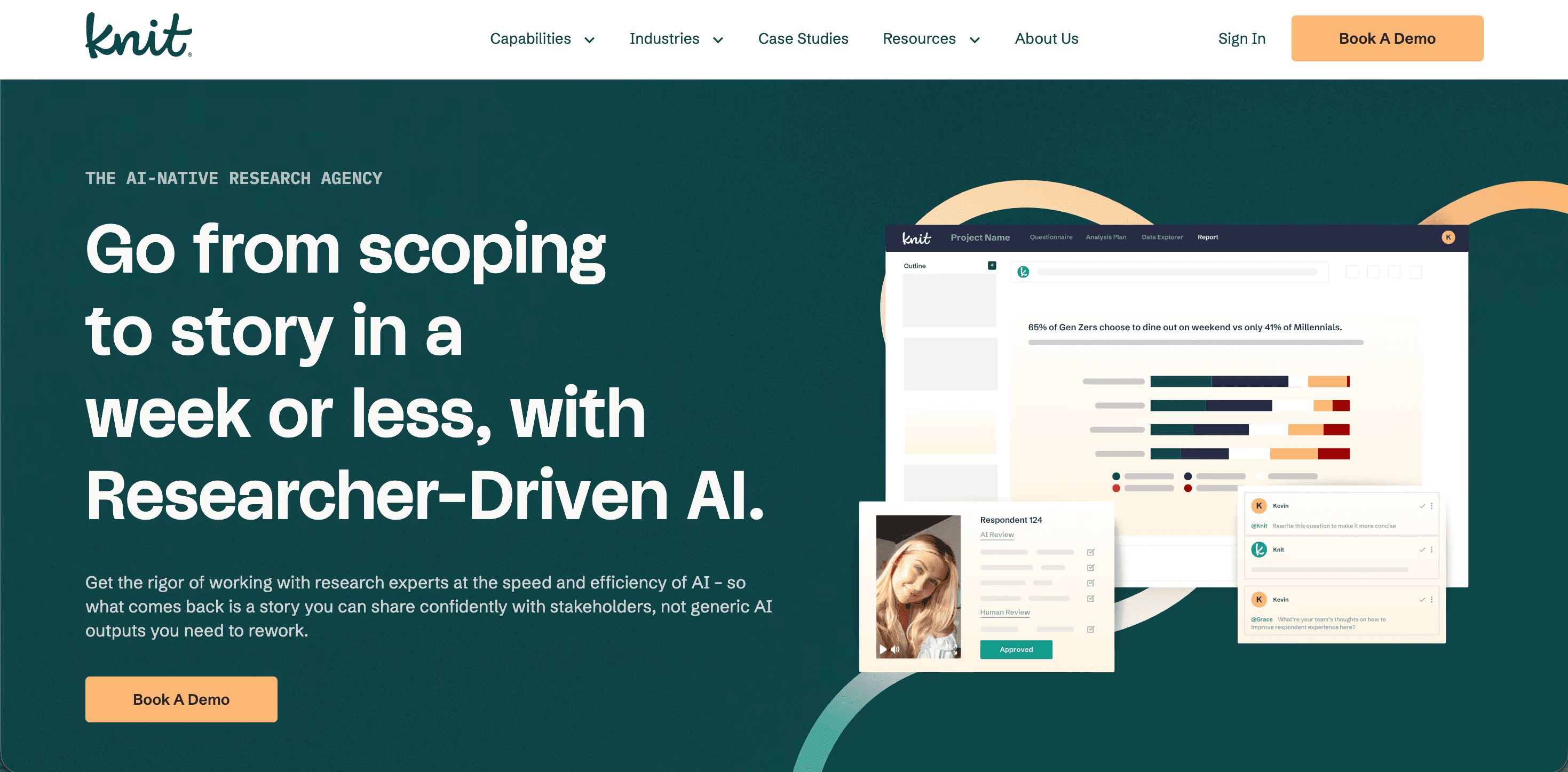
A hybrid qual and quant research platform that combines AI-moderated interviewing with survey-based quantitative research. Originally survey-focused, now expanded to conversational qualitative research alongside structured quant.
Who it's for
Research teams that need survey-style quant alongside AI-moderated qual interviews, and that value full-service research support.
Capabilities
AI-moderated interviews on top of a survey and quant platform
Combined qual and quant reporting
Full-service research support alongside DIY workflows
Integrated study management across methods
Panel included
Considerations
Knit's AI moderation depth and parallel session throughput trail platforms built specifically around interview moderation as the core workflow.
14. Discuss
Overview
Originally built for human-moderated 1:1 IDIs and focus groups. AI-moderated interviewing is a newer addition on top of that foundation.
Who it's for
Research teams and agencies that want both live human-moderated sessions and AI-moderated interviewing in one tool.
Capabilities
Video-enabled human-moderated 1:1 interviews and focus groups
AI-moderated interview capability added to the core platform
AI-assisted analysis and highlight reel generation
Session recording and transcript management
Research repository for past sessions
Considerations
Discuss's AI moderation is less mature than platforms built AI-first in continuous-session throughput, adaptive probing depth, and multimodal analysis. Teams prioritizing those capabilities will feel the gap.
Research scenario | Capability that matters most | Best fit |
|---|---|---|
Running hundreds of AI-moderated interviews in parallel | Integrated recruitment, adaptive probing, and structured outputs in one workflow | Listen Labs, Conveo, Outset, GetWhy |
UX and prototype testing inside product design workflows | Figma integration, screen-share support, and usability-specific metrics | Outset, Maze, Userology |
Video-first consumer research and creative reactions | Video modality with consumer panel access and automated theme detection | Conveo, Voxpopme, Strella, GetWhy |
Mobile-first and longitudinal in-context research | Diary studies and mobile-native fieldwork with AI analysis | Dscout |
Unmoderated video feedback from a large panel on demand | Task-based session capture with AI summaries | UserTesting |
Hybrid qual and quant in one workflow | AI moderation alongside survey-based quantitative research | Knit |
Centralizing existing qualitative research into a shared library | Tagging, cross-study search, and knowledge management | Marvin |
Mixing live human moderation with AI-moderated sessions | A platform supporting human-led IDIs and focus groups alongside AI moderation | Discuss |
Legacy survey programs that need AI summarization layered on | Form-based collection with generative features added on top | Qualtrics |
Enterprise-scale research across brand, product, creative, and UX in one workflow | Recruitment, moderation, fraud detection, analysis, and delivery without third-party tools, with regulated-industry compliance | Listen Labs |
How to Choose the Right AI Research Platform for Your Team
Start by matching platforms to the type of research your team runs most often and the stage of the research process where you need the most support. Some tools are built for a specific modality or workflow; others are designed to support the full lifecycle.
Questions to ask on every vendor call
How does the AI moderator handle a short or off-topic answer? Ask to see it.
What does the final deliverable look like? Not a description. The actual file.
Who owns the participant data, and is it used to train models?
How does fraud detection work, and is there a guarantee attached?
Where do participants actually come from, and what is their average number of studies per month?
Can every claim in the final output be traced back to a specific quote or video moment?
How does research compound across studies over time, or does every study start from zero?
What is the real time-to-first-insight for a study like ours? Not the best case.
Which integrations into our CRM, data warehouse, and BI tools are live today, not on the roadmap?
What is the pricing model, and what drives it: seats, studies, interview volume, or participants?
Frequently Asked Questions
What is AI research?
AI research, in the context of teams studying customers, users, and markets, refers to platforms that use AI across the research lifecycle. The category spans four approaches. AI-moderated interview platforms conduct live adaptive conversations with participants. AI-native hybrid platforms combine qual and quant in one workflow. AI-assisted analysis tools layer machine learning on top of existing research data. Legacy survey platforms have added generative summarization on top of form-based foundations. All get grouped under "AI research," but they solve different problems.
What is the best AI for research?
The honest answer depends on whether you are running one-off studies or continuous programs. For continuous enterprise research across brand, creative, product, and UX in one platform, Listen Labs is the strongest option, largely because of Mission Control, its cross-study knowledge base. For structured survey programs, Qualtrics remains dominant. For UX-only prototype testing, Outset, Maze, and Userology are all viable. The wrong move is picking a platform scoped to one use case when your roadmap covers several.
AI research vs traditional research: what actually changes?
Traditional qualitative research, run through agencies or manual interview workflows, takes weeks from brief to final report. Most of that time is recruitment, scheduling, moderation, and analysis. AI-moderated platforms that integrate the full workflow compress this to a matter of hours or days. The change is not just speed. AI can run many interviews in parallel without fatigue, apply consistent probing across languages, and generate auditable deliverables. Researchers still own study design and interpretation. The shift is in where their time goes.
Is AI research reliable?
Reliability depends on two things: the quality of the participant pool and whether findings can be traced back to source evidence. Fraud detection matters because bad participants produce bad data. Traceable outputs matter because stakeholders will challenge findings, and platforms that produce standalone AI summaries without evidence trails create a credibility gap on the first hard question. Platforms with verified panels and quote-level traceability produce data that holds up in executive reviews. Platforms without either do not.
Will participants open up to AI?
Research comparing AI-moderated to human-moderated sessions consistently finds participants share more candidly with AI, likely because there is less perceived social pressure. The quality of the experience depends on whether the AI actually probes. Platforms that run linearly through a script produce shallow results. Platforms that use adaptive probing, asking follow-ups when answers are brief or unclear, generate meaningfully longer and more substantive responses.
Does AI research replace researchers?
No. AI handles execution: moderation at scale, transcription, thematic clustering, deliverable generation. Researchers still own study design, interpretation, and translating findings into strategic decisions. What changes is where their time goes. Instead of managing logistics or sitting in moderation sessions, researchers focus on the parts of the work that require judgment.
What is the difference between AI-moderated interviews and AI surveys?
AI surveys are structured. They present a predetermined set of questions and can branch based on answer logic, but they do not respond to what a participant actually says. AI-moderated interviews are conversational. The AI listens to each response and decides in real time whether to ask a follow-up, request clarification, or move forward. The "why" behind a behavior rarely surfaces in a scripted sequence. It tends to emerge when a moderator probes further.
How secure is AI research data?
Enterprise teams should require SOC 2 Type II and GDPR compliance at minimum. Healthcare, pharmaceutical, and financial services typically require HIPAA and ISO certifications for AI systems, information security, and privacy. Before committing, confirm the certifications relevant to your industry, check the data retention policy, ask whether participant data is used to train models, and review access controls.
How do AI research platforms handle multiple languages?
Transcription quality in major languages is fairly standard. Where platforms diverge is in moderation quality in less common languages, translation accuracy, and whether emotional analysis extends beyond English. Some platforms cap language support at a narrow set, which becomes a constraint for global enterprise teams. Ask about the specific languages relevant to your markets and request sample output, not just a language count.